
Hacker News

The Bicycle and the Algorithm: Amber Case on Why AI Has It Backwards
Article URL: https://www.designwhine.com/amber-case-interview-why-ai-has-it-backwards/
Comments URL: https://news.ycombinator.com/item?id=49743450
Points: 1
# Comments: 0
Royal Enfield's Flying Flea C6 Touches Down in Europe
Article URL: https://www.irishnews.com/life/royal-enfields-flying-flea-c6-touches-down-in-europe-X27BGU34YVO4BLP4RCWHNTOX2A/
Comments URL: https://news.ycombinator.com/item?id=49743444
Points: 1
# Comments: 0
Show HN: Dishlist – my favorite things on the menu
Hi HN!
My friend and I wanted to rank our favorite breakfast burritos. Yelp and Beli allow users to rate or rank restaurants, but not individual dishes.
So I built dishlist, an iPhone app around the things on restaurant menus.
I schlepped around Dogpatch, Potrero Hill, and Mission Bay taking photos of restaurant menus. Then, I used Claude with my menu schema to turn the photos into structured data.
Garry Tan likes to say, "The rocks can talk." Also, "The rocks can see."
I represent the menu hierarchy in the database. LLMs can determine what type of thing each menu item is. This lets me index things like breakfast burritos across restaurants rather than just indexing the restaurants themselves.
The app suggests possible tags for a menu item. You decide which ones you want to use on your profile. You can build a list of your favorite breakfast burritos, pizzas, burgers, or whatever else you care about.
I value my privacy, so you can use the app without logging in at all. If you want to save menu items, you can sign in with Apple. I don't collect names, emails, or phone numbers.
If you want to share with friends, you can add a handle. You have to follow another user to see their dishlist, and they have to follow you to see yours. Follow requests are approved or denied by the user.
The app is currently available through TestFlight while the App Store submission is being reviewed.
https://testflight.apple.com/join/VB1YAe63
I'd love feedback on the idea, the search experience, and especially whether organizing things around individual menu items feels useful.
Comments URL: https://news.ycombinator.com/item?id=49743441
Points: 1
# Comments: 0
Show HN: Content-aware PII redaction with Jev in Postgres
Article URL: https://pg-redact.vercel.app
Comments URL: https://news.ycombinator.com/item?id=49743434
Points: 1
# Comments: 0
Ask HN: What Makes Tokens Expensive?
Are there really such architectural differences between for example sol and astra that makes astra twice more in token price? Or maybe token cost covers training expenses? For me it's hard to believe that astra need twice the computing power that sol needs...
Comments URL: https://news.ycombinator.com/item?id=49743419
Points: 1
# Comments: 0
The AI threat isn't what you think – The Econoclasts [video]
Article URL: https://www.youtube.com/watch?v=FOzijIeBGCg
Comments URL: https://news.ycombinator.com/item?id=49743418
Points: 1
# Comments: 0
Priest, Monk, and Mathematician
Article URL: https://logangraves.com/priest-monk-mathematician
Comments URL: https://news.ycombinator.com/item?id=49743400
Points: 1
# Comments: 0
How can I remove the Close button from my window caption?
Article URL: https://devblogs.microsoft.com/oldnewthing/20260911-00/?p=112691
Comments URL: https://news.ycombinator.com/item?id=49743398
Points: 1
# Comments: 0
MSVC C++23: constexpr cmath with LLVM Libc
Article URL: https://devblogs.microsoft.com/cppblog/msvc-c23-constexpr-cmath-with-llvm-libc/
Comments URL: https://news.ycombinator.com/item?id=49743394
Points: 1
# Comments: 0
Show HN: Prokop – Open-source coding environment with agents that learn
Article URL: https://github.com/capek-dev/prokop
Comments URL: https://news.ycombinator.com/item?id=49740924
Points: 1
# Comments: 0
Switch to Codex seamlessly when Claude Code is used up
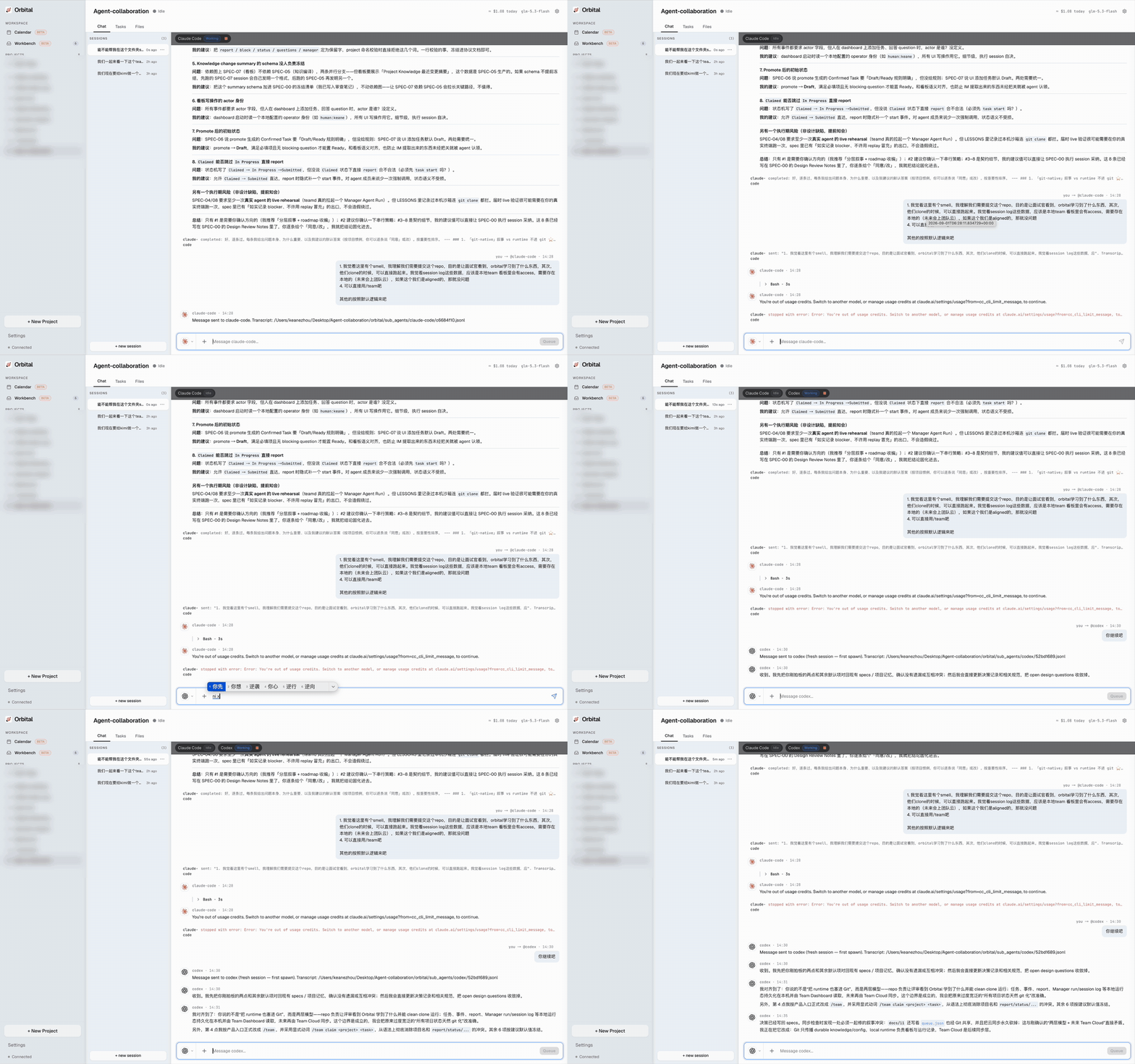
Article URL: https://raw.githubusercontent.com/zqiren/Orbital/main/docs/screenshots/handoff-codex-continue.gif
Comments URL: https://news.ycombinator.com/item?id=49740917
Points: 1
# Comments: 0
Mainline – A light macOS menu bar app to keep you on top of your GitHub PRs
Article URL: https://github.com/mthines/mainline
Comments URL: https://news.ycombinator.com/item?id=49740914
Points: 1
# Comments: 0
In-Region Routing: Keep Your Data in the US or EU
Article URL: https://openrouter.ai/blog/announcements/us-in-region-routing/
Comments URL: https://news.ycombinator.com/item?id=49740890
Points: 1
# Comments: 0
The jobs of the future may look more like legal jobs rather than engineering
Article URL: https://shrsv.hexmos.com/post/jobs-of-the-future-look-legal-not-engineering
Comments URL: https://news.ycombinator.com/item?id=49740861
Points: 1
# Comments: 0
King Charles warns of 'existential danger' of AI falling into wrong hands
Article URL: https://www.bbc.com/news/articles/c65ymj7njvl7o
Comments URL: https://news.ycombinator.com/item?id=49740857
Points: 1
# Comments: 0
Elliptic Curve Rank Leaderboard
Article URL: https://elliptic-rank.icarm.cloud/
Comments URL: https://news.ycombinator.com/item?id=49740855
Points: 1
# Comments: 0
Live AI model pricing and benchmark comparison tool with API
Article URL: https://cost.dev/models/
Comments URL: https://news.ycombinator.com/item?id=49740838
Points: 1
# Comments: 0
Ask HN: How about small technological solutions to bring oil prices back down?
The prices on diesel are approaching ludicrous. In my mind, this should be an opportunity for a new technological solution to be implemented.
AFAICT, one significant part of the problem is something like:
Huge hulking expensive iron delivery vessels chugging through the water get blown up by inexpensive distant ordinance delivery.
Thus, a general solution could be something like:
Transition to small, cheap and highly numerous delivery vessels to nullify the effectiveness of distant ordinance delivery.
My layperson conceptual solution:
Create synthetic (e.g., plastic, PVC, etc.) eel-shaped self-navigating "vessels" that provide delivery in very high volume (millions of such "vessels") through dangerous waters to be recovered in safe waters.
These could be manufactured into large rolls, à la inflatable packing, and filled using mechanical power (either any simple motor powered by whatever or even human-powered via crank handle).
Drive can be provided by whatever works: time the release of the vessels to go out with a tide current; small sails; solar-powered propellers, etc. Speed does not matter as the quantity can be so high that once the vessels are being recovered the volume being delivered will be massive. (Conceptually similar to the old saw about "never underestimate the bandwidth of a 747 full of tape.")
I really only provide the above to hopefully inspire people who have the talent and means to create something yet better than what we currently have so that we do not arrive at a very real problem of products such as diesel fuel being not only high in price, but largely unavailable, as we may currently be on course to experience.
Comments URL: https://news.ycombinator.com/item?id=49740835
Points: 1
# Comments: 1
I Don't Like LLMs
Article URL: https://martinfowler.com/articles/2026-dont-like-llms.html
Comments URL: https://news.ycombinator.com/item?id=49740834
Points: 1
# Comments: 0
Show HN: Dnswer – browser-based DNS change approval and multi-provider sync
Imagine you have to manage DNS for domains spread across multiple DNS providers. You want to apply consistent DNS settings across your zones but the only way is applying the same change manually zone by zone (using multiple control panels). Tedious and a mistake is bound to happen. You want to delegate permissions to other teams but many times the only way is handing out access to everything. If something breaks you have no idea who did it and what exactly was changed.
The existing solution is IaC. Tools like OctoDNS or DNSControl can help you with some of the problems described above. But they require the whole team to feel at home with setting up pipelines, command line tools and git.
With dnswer I want to provide the same level of structure, but in a browser:
- staging / preview before publishing DNS changes (edit and publish are separate roles)
- reusable blocks of records with per-zone variables (not a one-off template: update once, bulk-upgrade every zone that uses it)
- granular access control from full access down to write access on just a single record
- multi-provider sync with drift detection and resolution
- provision new zones at your provider(s), not only importing existing ones
- nameserver verification after changes (verifies that the change is live)
- for providers without an API, a shareable change request with on-demand re-verification (viewable without a dnswer account)
- modern record types (HTTPS/SVCB) and DANE/TLSA for mail, with cert-drift monitoring
- a zone logbook showing what changed, who did it, and why
There are a few ways you can learn more about it:
- Learn: https://dnswer.net/show/ (walkthroughs; annotated screenshots explaining how to use key features)
- Try it: https://app.demo.dnswer.net/ (sandbox with mock providers, free; sign up and verify your email to get in)
- Pricing: https://dnswer.net/pricing
If you want to try it with your own zones and API access to your DNS provider(s): I'm looking for up to ten teams (ideally managing 20+ domains across multiple providers) willing to manage real zones using dnswer. Not a big beta: I want to watch how it actually gets used and adapt things quickly. Free for the first 3 months, and early users keep their price for 2 years even after it goes up for new customers. If you're interested, reach out by emailing joost@dnswer.net.
A few things worth knowing before you do. dnswer is not in your resolution path: your records stay at your provider and your nameservers keep answering. If dnswer is down, DNS keeps resolving and you can still change records directly in your provider's control panel, you just lose the workflow on top until it is back. You can leave whenever you like: every zone exports as a BIND file with your record descriptions preserved as comments, so your documentation comes with you. Your provider credentials are encrypted at rest.
I've built it to solve the DNS problems I ran into in the last 20 years. I'd like to learn about other people's DNS problems as well.
Tech stack: Django/DRF, PostgreSQL, NATS, Lit web components, deployed with Ansible.
Comments URL: https://news.ycombinator.com/item?id=49740831
Points: 1
# Comments: 0